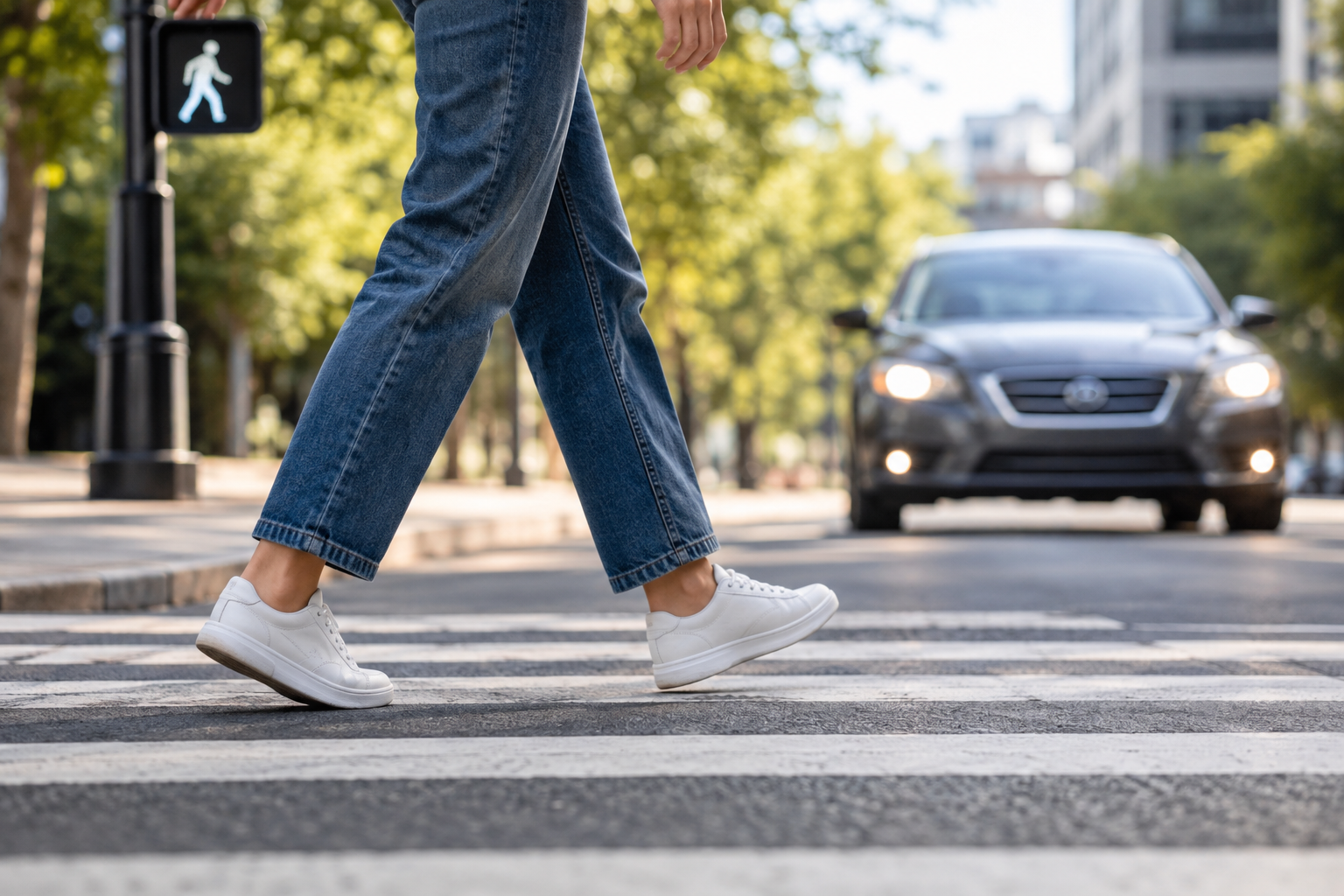
If you were hit by a car while walking or crossing the street in Texas, you may wonder who is responsible for the accident. Is the driver automatically at fault for hitting a pedestrian? Or can a pedestrian be held responsible for a collision?
The answer depends on the circumstances, including who had the right of way, where the pedestrian was crossing, whether traffic signals were present, and whether the driver exercised reasonable care to avoid the accident.
Under Texas law, pedestrians have certain responsibilities when crossing roadways, but drivers also have a duty to watch for pedestrians and take reasonable precautions to avoid collisions. Importantly, a pedestrian is not automatically at fault simply because they were crossing outside a crosswalk.
Who Has the Right of Way: A Pedestrian or a Car?
The Texas Transportation Code defines right of way as the right of a vehicle or pedestrian to proceed lawfully in preference to another vehicle or pedestrian when their paths could otherwise result in a collision.
Whether the pedestrian or driver had the right of way generally depends on where the pedestrian was crossing and whether traffic control signals were present.
Texas pedestrian right-of-way laws distinguish between pedestrians crossing at marked or unmarked crosswalks, pedestrians crossing outside crosswalks, and pedestrians crossing at intersections controlled by traffic signals. However, having the right of way does not automatically excuse a driver from responsibility for hitting a pedestrian.
Do Pedestrians Have the Right of Way in a Crosswalk in Texas?
Under Texas law, drivers generally must yield the right of way to pedestrians lawfully crossing in a crosswalk, subject to the applicable traffic signals and other statutory requirements. At a crosswalk without traffic control signals, a driver must yield to a pedestrian who is:
- On the half of the roadway on which the vehicle is traveling; or
- Approaching so closely from the opposite half of the roadway as to be in danger.
A pedestrian also has responsibilities when entering a crosswalk. For example, a pedestrian generally cannot suddenly leave a curb or other place of safety and enter the path of a vehicle that is so close that it is impossible for the driver to yield.
Whether the driver or pedestrian complied with these requirements may be important when determining fault after a pedestrian accident in Texas.
Can a Pedestrian Be at Fault for Crossing Outside a Crosswalk?
Yes. A pedestrian may be found partially or entirely responsible for an accident if they fail to follow applicable pedestrian traffic laws or otherwise act negligently.
Under Texas law, a pedestrian crossing a roadway somewhere other than a marked or unmarked crosswalk generally must yield the right of way to vehicles on the roadway.
However, this does not mean that a pedestrian who is hit by a car while crossing outside a crosswalk is automatically responsible for the accident.
Drivers still have a duty to exercise reasonable care, maintain a proper lookout, control their speed, and take appropriate precautions to avoid hitting pedestrians.
For example, if a driver is speeding, distracted, or fails to observe a pedestrian who is visible in the roadway, the driver’s actions may be relevant to determining fault even if the pedestrian was crossing outside a crosswalk.
Can You Sue a Driver if You Were Hit While Jaywalking?
Potentially, yes. A pedestrian who was jaywalking or crossing outside a crosswalk may still have a personal injury claim under Texas law.
Although the term jaywalking is commonly used to describe crossing a road outside a crosswalk, the legal question is whether the pedestrian violated an applicable law or failed to exercise reasonable care—and whether that conduct contributed to the collision.
The driver may also have been negligent.
For example, a pedestrian crossing outside a crosswalk may have failed to yield, but a driver who was texting, speeding, or not paying attention may also have contributed to the accident.
In those circumstances, Texas comparative fault laws may determine whether the pedestrian can recover compensation and whether that compensation should be reduced.
What Are the Rules for Pedestrians Crossing at Traffic Lights?
At intersections controlled by traffic signals, pedestrians must comply with applicable pedestrian control signals and traffic regulations. Generally, pedestrians should cross in accordance with the applicable WALK or other pedestrian signal indications.
Texas law also restricts diagonal crossings at intersections with traffic control signals unless the crossing is authorized by the traffic control devices. When a pedestrian is hit by a car at an intersection, determining fault may involve reviewing the traffic signals, the pedestrian’s movements, the driver’s actions, and whether either party failed to obey applicable traffic laws.
Does a Driver Have to Avoid Hitting a Pedestrian Even if the Driver Has the Right of Way?
Yes. Even when a driver has the right of way, Texas law still requires drivers to exercise appropriate care to avoid collisions. A driver’s responsibilities may include:
- Exercising the care that a reasonably prudent driver would exercise under similar circumstances;
- Controlling the vehicle’s speed as necessary to avoid a collision;
- Exercising due care to avoid colliding with a pedestrian on the roadway;
- Sounding the horn when necessary to provide a warning;
- Taking proper precautions upon observing a child or an obviously confused or incapacitated person on the roadway;
- Maintaining a proper lookout; and
- Paying attention to surrounding traffic, pedestrians, road conditions, and other potential hazards.
These responsibilities can become particularly important when an insurance company claims a pedestrian caused the accident because the pedestrian did not have the right of way. The driver may still be responsible if the evidence establishes that the driver failed to exercise reasonable care and that failure contributed to the collision.
What if Both the Pedestrian and Driver Were at Fault?
Texas follows a system of proportionate responsibility, also known as modified comparative fault. Under Texas law, an injured pedestrian generally may recover compensation if the pedestrian is found to be 50% or less responsible for the accident. However, the amount recoverable may be reduced by the pedestrian’s percentage of responsibility.
If the pedestrian is found to be more than 50% responsible, the pedestrian generally cannot recover damages.
For example, suppose a pedestrian suffers $100,000 in damages after being struck by a vehicle. If the pedestrian is found to be 20% responsible for the collision and the driver is found to be 80% responsible, the pedestrian’s recoverable damages would generally be reduced to $80,000. This means that even if a pedestrian was partially at fault for being hit by a car, the pedestrian may still be entitled to compensation.
What if a Driver Hits a Pedestrian in a Parking Lot?
Pedestrian accidents do not occur only at intersections or marked crosswalks. People can also be injured when vehicles strike them in parking lots, parking garages, driveways, and other areas where pedestrians and vehicles share space. Although the specific traffic laws that apply may depend on the location, drivers generally must exercise reasonable care under the circumstances.
For example, a driver who fails to maintain a proper lookout while backing out of a parking space may be responsible for injuries caused by striking a pedestrian. Determining liability requires examining the particular circumstances of the accident.
What if a Pedestrian Is Hit by a Truck or Commercial Vehicle?
A pedestrian accident involving an 18-wheeler, delivery truck, bus, or other commercial vehicle can raise additional liability questions. Depending on the circumstances, an investigation may involve the commercial driver’s speed, visibility, attention to surrounding traffic, compliance with applicable safety requirements, and actions immediately before the collision. If a commercial driver negligently strikes a pedestrian, the driver’s employer or another responsible party may also potentially be liable under applicable Texas law.
Because pedestrian accidents involving large commercial vehicles can cause catastrophic injuries, identifying and preserving relevant evidence may be particularly important.
What Evidence Can Help Determine Who Was at Fault for a Pedestrian Accident?
Determining whether a driver or pedestrian caused an accident may require reviewing evidence beyond the police crash report. Depending on the circumstances, important evidence may include:
- Surveillance or traffic-camera footage;
- Dash-camera video;
- Witness statements;
- Photographs of the accident scene;
- The location of crosswalks and traffic signals;
- The driver’s speed and braking actions;
- Vehicle damage and physical evidence;
- Cell phone records, when relevant and legally obtainable; and
- The police crash report.
Evidence concerning whether the driver was distracted, speeding, or failed to maintain a proper lookout may be particularly important when the insurance company argues that the pedestrian caused the accident.
What Damages Can You Recover After Being Hit by a Car in Texas?
If you were injured as a pedestrian because of another person’s negligence, you may be entitled to compensation for damages resulting from the accident. Depending on the circumstances, recoverable damages may include:
- Medical expenses;
- Lost wages;
- Loss of earning capacity;
- Physical pain and suffering;
- Mental anguish;
- Physical impairment;
- Disfigurement; and
- Other damages recognized under Texas law.
The damages available depend on the severity of the injuries, the circumstances of the collision, and the parties’ respective responsibility.
What Should You Do if the Insurance Company Says You Were at Fault for Being Hit by a Car?
If you were hit by a car while walking or crossing the street and the driver’s insurance company claims you were responsible, you should not automatically assume that the insurance company’s determination is correct.
An insurance adjuster may argue that you were crossing outside a crosswalk, failed to yield the right of way, or otherwise contributed to the collision. However, those allegations do not necessarily establish that you were entirely responsible for the accident. An investigation may reveal that the driver was speeding, distracted, failed to keep a proper lookout, or otherwise failed to exercise reasonable care.
An attorney can evaluate the applicable pedestrian right-of-way laws, investigate the collision, and determine whether you may have a claim despite allegations of comparative fault.
Talk to a Texas Pedestrian Accident Attorney About Your Injuries
If you were hit by a car, truck, or commercial vehicle while walking or crossing the street in Houston or anywhere in Texas, Mostyn Law can help determine who may be legally responsible for your injuries.
Our Texas pedestrian accident attorneys can investigate the circumstances of the collision, evaluate whether the driver violated applicable traffic laws, review allegations that you were partially at fault, and pursue compensation from the responsible parties and insurance companies.
Contact Mostyn Law today for a free consultation about your Texas pedestrian accident claim.



 (832) 844-5116